

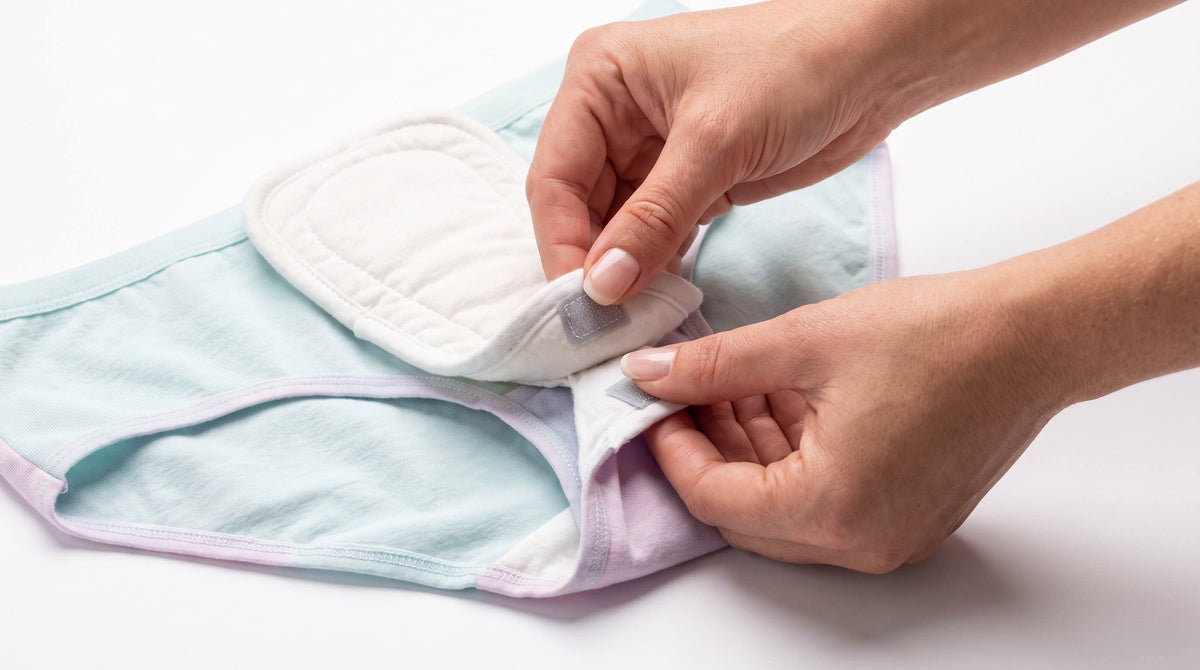
Rachel, 39, has run the Brighton half-marathon four times. She knows her body, trusts her kit, and has strong opinions about her running shorts. When stress incontinence arrived — quietly, then insistently — after the birth of her second child, she wasn't prepared to rethink every garment in her drawer. "I didn't want to throw everything out," she told a friend at parkrun. "I just wanted something I could clip in and forget about." She found it in the Orykas Reusable Velcro Pad: a washable, bamboo-fibre incontinence pad designed to fasten securely into almost any pair of knickers you already own.
Rachel's experience is far from unusual. According to Bladder & Bowel UK, urinary incontinence affects roughly one in three women at some point in their lives, yet the majority go without proper protection for years — often because conventional solutions feel intrusive, visible, or wasteful. The Orykas Velcro Pad was designed to close that gap.
What Is a Velcro Clip-In Incontinence Pad — and How Does It Work?
A reusable incontinence pad with a velcro clip-in fastening is exactly what it sounds like: a contoured absorbent pad that attaches to the inside gusset of your existing knickers using soft hook-and-loop (velcro-style) strips. Unlike disposable pads, which rely on a single-use adhesive strip that can shift, bunch, or leave residue, a velcro fastening holds the pad firmly in place throughout movement — whether you are walking to the shops, doing a Pilates class, or running five kilometres along the seafront.
The Orykas version is constructed from OEKO-TEX Standard 100 certified bamboo fibre. This certification, issued by independent testing institutes, confirms that every component of the fabric — threads, dyes, and finishes — has been tested for harmful substances and meets strict human-ecological safety standards. For skin that is already under the stress of frequent moisture exposure, that matters.
The pad is machine-washable at 40°C and designed to last two to three years under normal use — representing a significant saving compared with the lifetime cost of single-use alternatives, which the NHS estimates can run to hundreds of pounds annually for women with moderate leakage.
The Features That Make a Real Difference
Not all reusable pads are created equally. When evaluating any reusable incontinence pad UK velcro clip-in option, the following features distinguish a product that performs from one that simply promises:
- Secure fastening: The velcro attachment must hold during dynamic movement. The Orykas pad uses a reinforced hook-and-loop system wide enough to distribute pressure evenly, preventing curling at the edges — a common complaint with narrower adhesive designs.
- Moisture-wicking bamboo fibre: Bamboo fabric draws moisture away from the skin at a rate measurably faster than cotton, helping to prevent the dermatitis and skin breakdown that can develop with prolonged exposure to damp material. This is particularly relevant for women who are active or who spend long periods seated.
- Odour control: Bamboo fibre contains a naturally occurring antimicrobial agent called bamboo kun, which inhibits bacterial growth and, by extension, the production of odour. This is a genuine structural property of the material, not a chemical treatment that washes out over time.
- Trim profile: The pad is contoured to sit flat beneath close-fitting clothes, including running tights and tailored trousers, without visible lines or bulk.
- Washability: Machine-washable at 40°C, the pad can be laundered with your normal whites or delicates cycle. No specialist detergents are required, though fabric conditioner should be avoided as it can reduce absorbency over time.

Who Benefits Most From a Clip-In Pad?
The velcro pad format is particularly well-suited to several groups of women:
Women with stress incontinence — the most common type in the UK, often triggered by coughing, sneezing, laughing, or exercise — tend to experience short, sharp leaks rather than sustained flow. A clip-in pad provides targeted protection without the bulk of a full incontinence garment.
Perimenopausal and postmenopausal women frequently find that declining oestrogen levels affect the elasticity of the urethra and pelvic floor. As Bladder & Bowel UK notes, this can bring leaks that were previously managed with pelvic floor exercises back to the surface. A reusable pad allows women to manage symptoms discreetly while pursuing other treatment avenues — including the pelvic floor physiotherapy that NICE guidelines recommend as a first-line intervention.
Postpartum women, whose pelvic floor may take up to a year to recover fully after vaginal delivery, often find that single-use maternity pads are too bulky for everyday use once the immediate postnatal period has passed. A clip-in pad bridges the gap between maternity protection and full recovery.
Women who run, cycle, swim, or practise high-impact exercise — like Rachel — need a fastening that stays put. Adhesive pads can slip or bunch during movement. A velcro pad that is securely anchored to the gusset of technical fabric performs significantly better in dynamic conditions.

Practical Guidance: Getting the Most From Your Pad
A few straightforward habits will extend the life of your pad and optimise its performance:
- Rinse promptly after use. A quick cold rinse before the pad goes into the laundry basket prevents staining and reduces odour. Cold water is important here — hot water sets protein-based stains.
- Wash at 40°C. This temperature is sufficient to hygienically clean bamboo fabric without degrading the fibres or the velcro fastening.
- Air-dry where possible. Tumble drying on a high heat setting will shorten the lifespan of both the bamboo fabric and the velcro strips. Low heat or air-drying preserves both.
- Avoid fabric conditioner. Conditioners coat fabric fibres, which reduces their ability to wick moisture. Use a gentle, conditioner-free detergent.
- Carry a small wet bag. For women who are out and about, a waterproof pouch allows a used pad to be stored hygienically until it can be washed. This is particularly useful for runners changing after a race or commuters who work long days away from home.
What the NHS and Bladder & Bowel UK Recommend
The NHS recommends that women experiencing urinary incontinence speak to their GP, who can refer them to a continence nurse specialist for a personalised assessment. First-line treatments — pelvic floor muscle training, bladder retraining, and lifestyle modifications — address the underlying cause of leakage. Continence products such as reusable pads are understood to be an important part of managing symptoms while those treatments take effect, or for women for whom the condition is ongoing.
Bladder & Bowel UK, the UK's leading patient charity in this field, actively encourages the use of reusable continence products on environmental and economic grounds, noting that disposable pads contribute significantly to household waste and landfill pressure. Their published guidance suggests that washable alternatives are appropriate for women with light to moderate leakage who have access to regular laundry facilities.
If you are experiencing new or worsening symptoms, or if leakage is accompanied by urgency, pain, blood in the urine, or frequent urinary tract infections, speak to your GP or call NHS 111. A continence nurse specialist can assess the type and severity of your incontinence and recommend the most appropriate combination of treatment and products.
The Environmental and Financial Case for Switching
A single disposable incontinence pad takes roughly 500 years to decompose in landfill. For a woman who uses two to three pads per day, that represents more than a thousand pads entering the waste stream every year — from one household alone.
The financial savings of switching to reusables are equally striking. At typical retail prices, disposable pads for light-to-moderate incontinence cost between £3 and £6 per pack, with frequent users spending upwards of £150 per year. A reusable pad that lasts two to three years pays for itself many times over within the first twelve months.
It is also worth noting that UK VAT relief is available on washable incontinence products under the HMRC disability-products scheme for individuals with a chronic condition. Women purchasing Orykas products to manage ongoing incontinence may be eligible to buy without paying the standard rate of VAT — a reduction worth noting when calculating the true cost of reusable versus disposable options. If you are uncertain about eligibility, HMRC's guidance or a call to your GP can clarify whether your circumstances qualify.

Pair Your Clip-In Pad With Orykas Washable Knickers
The Orykas Velcro Pad is designed to work with knickers you already own — but it performs at its very best when paired with Orykas's own range of washable incontinence knickers, which are engineered with gusset dimensions and fabric composition optimised for the pad's fastening system.
For women with heavier leakage, or those who prefer all-in-one protection without managing a separate pad, the Women's Washable Incontinence Pants for Heavy Leakage offer a built-in multi-layer absorbent gusset in the same OEKO-TEX certified bamboo fibre. They are machine-washable at 40°C and designed for a two-to-three-year lifespan.
Women who prefer higher coverage and abdominal support may prefer the Women's High-Waisted Washable Incontinence Pants, which combine a secure, flattering fit with the same bamboo-fibre absorbent core. For everyday elegance without compromising on protection, the Women's Lace-Waistband Washable Incontinence Pants offer a trim, feminine silhouette that sits discreetly beneath tailored clothing.
All Orykas garments are OEKO-TEX Standard 100 certified and may be eligible for purchase under the UK VAT relief scheme for continence products.
Related Orykas UK Advice
- Urinary incontinence in women: natural treatment, what really works
- Urinary Leaks in Women: Causes, Types, and When to See a Doctor
- How to stop urinary leaks in women: complete solutions
- Urinary protection for women: complete 2026 guide
Frequently Asked Questions
Will the Orykas Velcro Pad work with any pair of knickers?
The pad is designed to attach to the gusset of most standard knickers using hook-and-loop velcro strips. It performs best with knickers that have a smooth, flat gusset — cotton, bamboo, or synthetic. Very thin or lacy gussets may not provide sufficient surface area for a secure hold. For the most reliable fit, pairing the pad with Orykas washable knickers ensures full compatibility.
How often should I change the pad?
This depends on the volume of leakage you experience. For light stress incontinence — small leaks triggered by coughing, sneezing, or exercise — many women find one or two pads sufficient for a full day. For heavier or more frequent leakage, it is advisable to change the pad every three to four hours. A continence nurse specialist can advise on the right product and change frequency for your specific pattern of leakage.
Is bamboo fabric genuinely better than cotton for incontinence pads?
Bamboo fibre has a measurably faster moisture-wicking rate than standard cotton, which means it moves liquid away from the skin more quickly. This reduces the risk of irritation and skin breakdown associated with prolonged moisture exposure. Bamboo also retains its antibacterial properties through repeated washing — unlike some treated cotton fabrics, where antimicrobial finishes can diminish over time.
Can I claim VAT relief when buying Orykas products?
UK VAT relief is available on continence products for individuals with a chronic condition that causes incontinence, under the HMRC zero-rating scheme for disability products. If your incontinence is ongoing rather than temporary, you may be eligible to purchase without paying standard-rate VAT. Eligibility criteria are set by HMRC; your GP or continence nurse specialist can confirm whether your condition meets the relevant definition. Orykas provides the necessary VAT relief declaration process at checkout.
When should I see my GP rather than managing symptoms with pads alone?
Pads are a helpful management tool, but they do not treat the underlying cause of incontinence. The NHS and NICE recommend speaking to your GP if leakage is new, worsening, or affecting your quality of life. You should also seek prompt advice if you experience urgency incontinence (a sudden, strong urge to urinate that is difficult to defer), pain, blood in the urine, recurrent urinary tract infections, or symptoms that began after a fall or injury. Your GP can refer you to a continence nurse specialist who will carry out a thorough assessment and advise on the combination of treatment and products most appropriate for you.
Sources and further reading: NHS – Urinary incontinence (nhs.uk/conditions/urinary-incontinence); NHS – Urinary incontinence treatment (nhs.uk/conditions/urinary-incontinence/treatment); Bladder & Bowel UK – Patient guidance and reusable product resources (bladderandbowel.org.uk); NICE – Urinary incontinence and pelvic organ prolapse in women: management (NICE guideline NG123, updated 2019); HMRC – VAT relief for disabled people and people with long-term conditions (gov.uk). This article is for informational purposes only and does not constitute medical advice. Always consult your GP or a qualified healthcare professional regarding symptoms of urinary incontinence.
Share:
High-Waist vs Mid-Rise Incontinence Knickers: Which Style Suits Your Body?
9 Travel Essentials British Women With Bladder Leaks Should Always Pack