

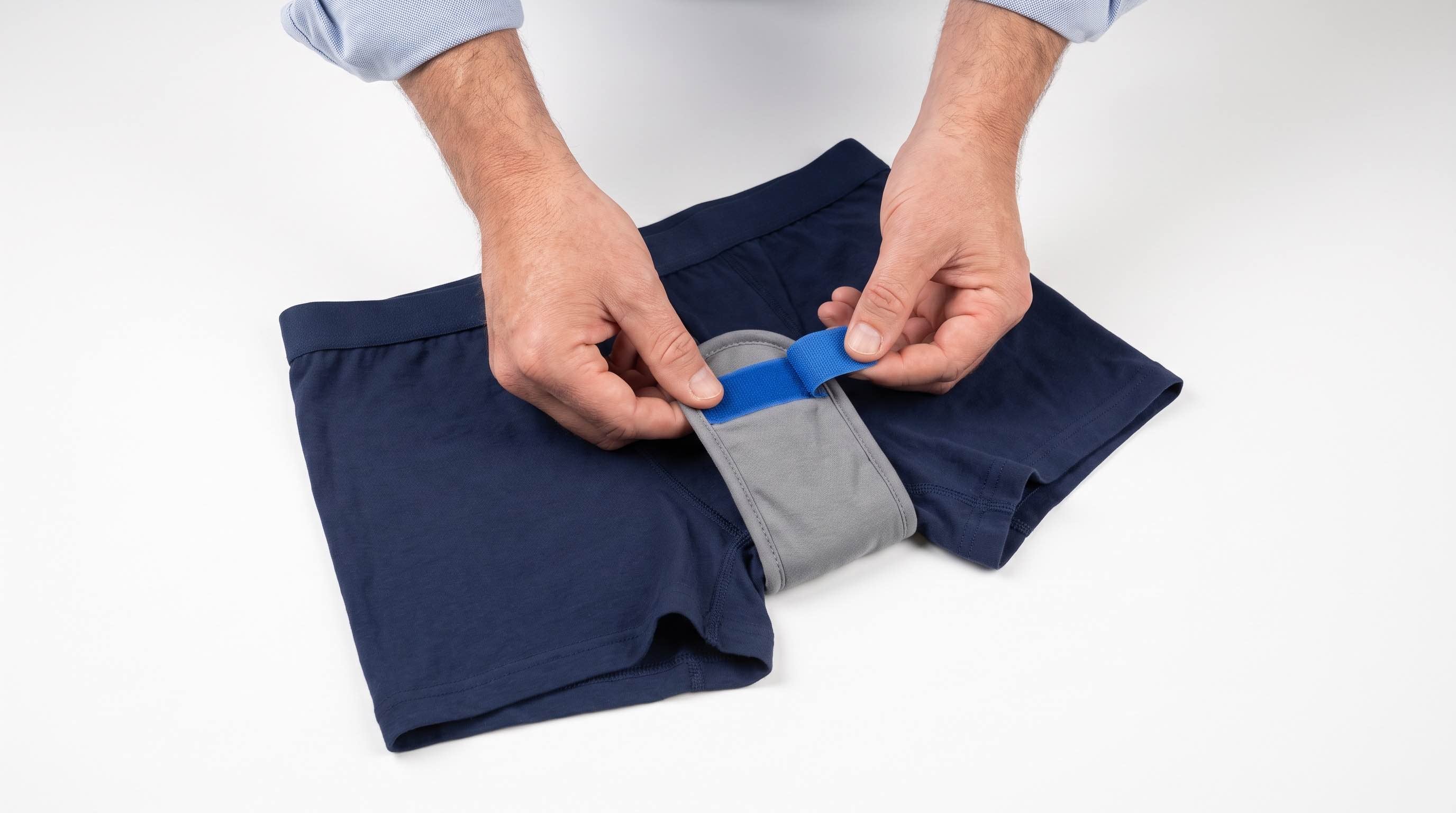
Dave is a 55-year-old plumber from Birmingham. He spends most of his working week crawling under kitchen units, climbing into loft hatches, and driving between jobs in a van with no convenient service station in sight. Like roughly one in three men over 50 in the UK, Dave lives with light-to-moderate urinary leakage — mostly post-void dribble and the odd stress leak when he's shifting heavy pipe. He didn't want to overhaul his entire workwear routine. He just needed a little extra insurance tucked into the boxers he already trusted. That's exactly the gap the Orykas Reusable Velcro Pad for Men is designed to fill: a discreet, washable add-on that drops into any boxer short, stays put all day, and comes home in the wash rather than landfill.
Why Men With Bladder Leaks Often Need a Two-Layer Approach
If you're managing bladder leaks, you've probably already discovered that no single product works perfectly for every situation. The NHS acknowledges that men experience different leakage patterns than women — post-void dribble (those frustrating drops that appear minutes after you've zipped up) is particularly common, as is stress leakage triggered by physical exertion such as lifting, bending, or coughing. According to Bladder & Bowel UK, these patterns often require layered protection: a breathable outer garment that provides baseline coverage, combined with a targeted inner pad that absorbs the brunt of any unexpected leak.
The Orykas Reusable Velcro Pad is built around this logic. Rather than forcing you to choose between your preferred boxers and a dedicated incontinence garment, it attaches directly to the gusset of virtually any underwear via a Velcro strip, sitting snugly against the body where leakage occurs. No adhesive residue, no bunching, no rustling — just quiet, reliable protection that moves with you.
What Makes the Velcro Attachment System So Practical for Working Men
Conventional disposable pads for men rely on a peel-and-stick adhesive strip. For anyone doing physical work, that adhesive often fails mid-morning — the pad shifts, bunches, or peels away entirely. The Orykas pad uses a low-profile Velcro fastening instead, which grips the fabric of your existing underwear far more securely than adhesive ever could. You feel nothing unusual when moving around, bending at the knee, or crouching in a tight space.
The practical benefits for men like Dave are significant:
- Works with your existing wardrobe: No need to replace every pair of boxers. Clip the pad in, go to work, unclip it at the end of the day.
- Stays in position during physical activity: Whether you're lifting a boiler or navigating a loft ladder, the Velcro holds the pad flat and centred.
- Quick mid-day swap if needed: On longer jobs, you can carry a spare pad in your tool bag and swap it out discreetly in any loo — no full wardrobe change required.
- Completely silent: Unlike crinkle-plastic disposables, the bamboo-fibre shell is soft and noise-free against fabric.

The Bamboo Fibre Difference: Comfort You Can Feel After Hour Eight
Most men who've tried standard disposable pads report the same complaint: by lunchtime, the plastic backing feels hot, clammy, and uncomfortable. This is a predictable consequence of synthetic materials that trap heat and moisture against the skin.
The Orykas pad is constructed from OEKO-TEX Standard 100 certified bamboo fibre — a material that is independently tested and verified to be free from harmful substances. Bamboo fibre is naturally temperature-regulating, drawing moisture away from the skin and allowing it to disperse rather than pooling. This matters enormously if you're eight hours into a working day and can't stop to change. Skin irritation, rashes, and odour are all significantly reduced compared with synthetic alternatives.
The inner absorbent core locks liquid away quickly — important for managing the sudden, small-volume leaks characteristic of post-void dribble — while the outer bamboo layer remains dry to the touch. For men who've experienced chafing or skin breakdown from prolonged pad use, this breathability is genuinely life-changing.

Reusable, Machine-Washable, and Built to Last — The Environmental and Financial Case
The average man managing light leakage goes through two to four disposable pads per day. At typical UK prices, that's between £600 and £1,200 per year — money that goes straight to landfill. The Continence Foundation of Australia (whose research is widely cited in UK continence care literature) estimates that reusable products reduce waste by up to 95% over their lifespan compared with disposables.
The Orykas Reusable Velcro Pad is machine-washable at 40°C and built to last two to three years with normal use. A small initial investment replaces what would otherwise be thousands of single-use items. For a working man on a standard income, that's a meaningful saving — and one that becomes even more significant when you factor in the VAT position.
VAT relief under the HMRC disability-products scheme: If you have a chronic condition causing incontinence — this includes conditions such as an overactive bladder, post-prostatectomy incontinence, neurological conditions, and others — you may be entitled to purchase eligible incontinence products zero-rated for VAT. This removes 20% from the purchase price immediately. Orykas UK products qualify under this scheme; you simply confirm your eligibility at checkout. If you're unsure whether your condition qualifies, speak to your GP or continence nurse specialist, or call NHS 111 for guidance.
How to Use the Orykas Reusable Velcro Pad Correctly
Getting the most from the pad takes no more than thirty seconds to learn:
- Prepare your underwear: The pad attaches to the inside gusset of any boxer short or brief. It works best with close-fitting underwear rather than very loose boxers, as a snugger fit keeps the pad correctly positioned.
- Position the pad: Place it centrally along the gusset with the absorbent side facing up (towards the body). Press the Velcro strip firmly to secure it against the fabric.
- Check alignment: The pad should sit comfortably without extending beyond the edges of the gusset. Adjust until it lies flat.
- At end of use: Peel away the Velcro, rinse the pad under cool water, and machine-wash at 40°C. Do not tumble dry on high heat — air-dry or use a low setting to preserve the bamboo fibres.
- Rotate your pads: Having two or three pads in rotation allows one to dry while you use another — ideal for working days that run long.
When to Use the Pad Alone, and When to Pair It With Specialist Underwear
For very light leakage — the occasional post-void drip, or a brief stress leak during exercise — the Velcro pad clipped into your standard underwear will often be entirely sufficient. However, many men find that for moderate leakage, combining the pad with a dedicated pair of washable incontinence boxer briefs provides a more robust safety net. The outer garment adds a secondary absorbent layer and ensures that even if leakage exceeds the pad's capacity, it does not reach your outer clothing.
This two-layer approach is particularly valuable in situations where you know you'll be away from facilities for an extended period — long drives, outdoor work in remote locations, or any job where stopping to use the loo is genuinely difficult. It's also recommended during the early weeks following prostate surgery, when leakage volumes can be less predictable and the consequences of an outer garment leak are more stressful to manage.
If you are unsure which level of protection is right for your situation, a continence nurse specialist can assess your leakage pattern and recommend an appropriate product combination. Your GP can refer you, or you can self-refer through many NHS continence services — search for your local service via the NHS website.
Recommended Orykas UK Products to Pair With Your Velcro Pad
Whether you want to use the Velcro pad alone or build a layered protection system, Orykas UK has a range of washable incontinence boxer briefs designed specifically for men. All are made from OEKO-TEX Standard 100 certified bamboo fibre, machine-washable at 40°C, and built to last two to three years:
- Men's Washable Incontinence Boxer — Our flagship men's garment, combining a built-in multi-layer absorbent gusset with a breathable bamboo outer. Ideal for moderate leakage and long working days.
- 3 Pack Men's Light Leak Boxer Briefs — A value pack designed for everyday use with light leakage. The slimline profile works beautifully alongside the Velcro pad for added confidence without bulk.
- 3 Pack Ultra Absorbent Men's Incontinence Briefs — For heavier leakage or situations where you need maximum protection, this pack provides substantial absorbency in a discreet brief cut.
All eligible products qualify for VAT relief under the HMRC disability-products scheme if you have a chronic incontinence condition — simply confirm your eligibility during checkout.

Related Orykas UK Advice
- What are the best protection options for men with bladder leaks?
- Urinary incontinence after prostate surgery: how long does it last and what are the solutions?
- How to stop urinary leaks in men?
- Urinary Leaks and the Prostate: Understanding the Connection
- Why do I have urinary leaks after I have finished urinating?
Frequently Asked Questions
Will the Velcro pad work with any type of men's underwear?
The pad is designed to clip into the gusset of standard boxer briefs, briefs, and close-fitting boxers. It works best with underwear that has a reasonably snug fit — very loose, baggy boxers may not hold the pad firmly enough in place during physical activity. For active work, pairing the pad with one of the Orykas fitted incontinence boxer briefs gives the most secure result.
How much leakage can the pad absorb?
The Orykas Reusable Velcro Pad is designed for light-to-moderate leakage — specifically the kind of post-void dribble and stress leakage that many men experience. It is not intended as the sole protection for heavy or frequent leakage. If your leakage is more significant, we recommend using the pad alongside one of the Orykas ultra-absorbent incontinence boxer briefs, and discussing your situation with a continence nurse specialist who can help you find the right combination.
Is it hygienic to reuse the pad day after day?
Yes — provided you wash it correctly after each use. Rinse the pad under cool water as soon as practical after removal to flush out any urine, then machine-wash at 40°C. The bamboo-fibre construction resists bacterial growth and odour more effectively than synthetic materials, and regular washing at 40°C is sufficient to maintain hygiene. Do not share the pad with anyone else, and replace it if you notice any deterioration in the fabric or absorbency — typically after two to three years of regular use.
Can I claim VAT relief on the Orykas pad and boxer briefs?
If you have a chronic condition that causes urinary incontinence — such as an overactive bladder, post-prostatectomy incontinence, multiple sclerosis, or another qualifying condition — you may be eligible to purchase incontinence products zero-rated for VAT under HMRC's relief for disabled people scheme. This is a significant saving of 20% off the purchase price. You declare your eligibility at checkout; Orykas UK does not require a formal medical certificate, but you should be confident that your condition is chronic and ongoing. If you have any doubt, speak to your GP or contact HMRC directly for guidance.
When should I see a GP about my bladder leaks rather than just managing them with pads?
Pads and protective underwear are excellent management tools, but they do not treat the underlying cause of incontinence. The NHS recommends that men experiencing new or worsening urinary symptoms — including leakage, urgency, frequency, or difficulty passing urine — speak to their GP. Many causes of male incontinence are treatable, and a GP can refer you to a continence nurse specialist or urology service. You should seek prompt medical advice if you notice blood in your urine, significant pain, or a sudden marked change in your bladder habits. In urgent situations outside of GP hours, call NHS 111.
Sources and further reading: NHS — Urinary incontinence in men (nhs.uk); Bladder & Bowel UK — information and resources for adults with bladder and bowel conditions (bbuk.org.uk); NICE Clinical Guideline CG171 — Urinary incontinence in neurological disease; HMRC — VAT relief for disabled people and people with long-term conditions (gov.uk). The information in this article is for general guidance only and does not constitute medical advice. Always consult your GP or a qualified continence nurse specialist for advice tailored to your individual circumstances.
Share:
Incontinence Underwear for British Men: Briefs vs Boxer Briefs — Which Cut Is Right?
Colorectal Surgery and Bladder Function in Men: A Recovery Guide