

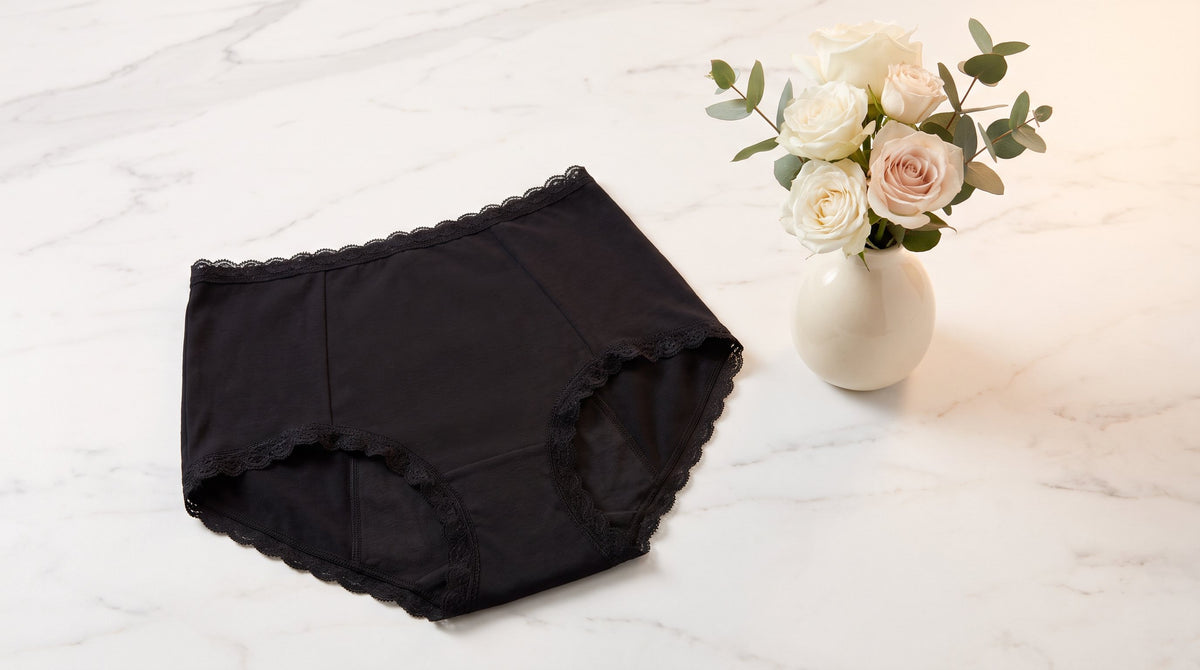
Sarah had spent twelve years buying lingerie for one of Britain's best-known department stores. She knew thread counts, lace patterns, and underwire construction better than most. So when her own GP mentioned washable incontinence knickers following a stress incontinence diagnosis after her second child, her first reaction was blunt: "I thought they'd be hideous. Big, beige, and medicalised. The kind of thing you'd hide at the bottom of your drawer." Six months later, she wears a lace-waistband pair every day and has quietly recommended them to three colleagues who had no idea she was dealing with leaks at all. Her change of heart is the story of an entire category that has quietly transformed itself — and if you've been putting off addressing your own leaks because you can't face giving up pretty knickers, this guide is for you.
Why So Many Women Still Settle for Pads (When They Don't Have To)
Urinary incontinence affects roughly one in three women in the UK at some point in their lives, according to the NHS, yet it remains one of the most under-discussed health topics in the country. A significant proportion of women manage their leaks with disposable pads tucked into ordinary knickers — an approach that works after a fashion but comes with its own frustrations: rustling, visible bulk, constant purchasing, and the persistent worry about odour.
What fewer women realise is that washable incontinence knickers have advanced enormously in the past decade. The category has moved well beyond the clinical, high-waisted styles that once dominated pharmacy shelves. Today, you can find styles with delicate lace waistbands, smooth microfibre outer shells, and cut profiles indistinguishable from premium everyday lingerie — while delivering genuine leak protection built directly into the gusset.
Bladder & Bowel UK actively encourages women to explore washable alternatives as part of a sustainable, dignity-centred approach to managing incontinence. The shift in thinking is medical as well as aesthetic: the right product supports the psychological wellbeing of the person wearing it, not just the practical need.
Understanding How Leak-Proof Knickers Actually Work
Before we get to lace, it helps to understand the engineering. Washable incontinence knickers use a layered gusset construction — typically three to five layers of specialist fabric — to absorb, lock away, and neutralise moisture. In high-quality garments, the layers work as follows:
- Inner moisture-wicking layer — draws fluid away from the skin immediately, keeping you feeling dry
- Absorbent core — holds fluid securely; in bamboo-fibre knickers, this layer also has natural antibacterial properties
- Leak-resistant outer layer — prevents fluid passing through to clothing
The gusset sits within an otherwise conventional-looking garment. From the outside — and crucially, through clothing — there is nothing to distinguish a well-made pair of washable incontinence knickers from ordinary underwear. That matters enormously for confidence.

Lace Incontinence Knickers: The Honest Pros and Cons
Let's be straightforward. Lace and leak-proofing involve genuine design trade-offs, and it's worth understanding both sides before you buy.
The Case For: Why Lace Works Better Than You'd Think
- Psychological lift — this is not trivial. Women who feel good in their underwear report greater confidence day-to-day. Managing a chronic condition is easier when your clothing doesn't feel like a medical uniform.
- Invisible under clothing — lace waistbands and smooth outer shells eliminate the visible panty lines that bulkier designs can create. Under fitted trousers or a dress, a lace-trim pair is genuinely undetectable.
- Fabric breathability — quality lace trim is open-weave, which combined with a bamboo-fibre core provides better airflow than solid synthetic constructions.
- Modern cut options — brief, bikini, and high-waisted silhouettes are all available with lace detailing. You are not limited to one style.
The Honest Caveats
- Lace requires gentler care — though most quality pairs are machine-washable at 40°C in a laundry bag, aggressive washing cycles can stress lace trim over time. Follow care labels.
- Lace is decorative, not absorbent — the protection comes from the gusset, not the lace panel. A pretty waistband does not improve absorbency. Verify the absorbency rating (measured in millilitres) before purchasing.
- Fit is non-negotiable — lace waistbands can roll or cut in if sizing is incorrect. Always size to your hip measurement, not your usual dress size, and refer to the brand's specific size guide.

Why Bamboo Fibre Makes a Meaningful Difference
Not all washable incontinence knickers are made equal, and fabric choice is where much of the quality gap lies. Bamboo fibre has become the material of choice for leading brands for several evidence-backed reasons:
- Natural antibacterial properties — bamboo contains a bio-agent called bamboo kun that inhibits bacterial growth, reducing the risk of odour and helping to maintain intimate health
- Softness and skin tolerance — bamboo-derived fabric is exceptionally gentle against sensitive skin, an important consideration for women who experience skin irritation from prolonged pad use
- Moisture management — bamboo fibre wicks moisture three times faster than cotton, keeping you drier between toilet visits
- Environmental credentials — bamboo is a fast-growing, low-water crop. Washable knickers with a two-to-three-year lifespan generate substantially less waste than decades of disposable pads
Look for garments certified to OEKO-TEX Standard 100, which means the fabric has been independently tested and verified to be free from harmful substances. This certification matters particularly for items worn close to sensitive skin over extended periods.
How to Choose the Right Style for Your Needs
Choosing washable incontinence knickers involves two practical decisions: absorbency level and cut. Getting both right means the garment works invisibly in your life rather than adding anxiety to it.
Matching Absorbency to Your Leakage
Be honest with yourself about your leakage pattern. Light stress incontinence — a small leak during a cough, sneeze, or jumping — is very different from heavier urgency leakage. If you are unsure, tracking your leaks for a few days (volume, frequency, trigger) is recommended by Bladder & Bowel UK as a useful starting point before any product or treatment decision. A continence nurse specialist, accessible through your GP or NHS referral, can carry out a more detailed assessment and help you understand whether pelvic floor rehabilitation might reduce your need for protection over time.
Choosing Your Cut
- Brief or full brief — maximum coverage, ideal for heavier leakage or for women who want a secure, comfortable fit throughout the day
- High-waisted — provides gentle abdominal support, popular after surgery or for women with core weakness; sits above the natural waistline for a smooth silhouette under fitted clothing
- Lace-waistband brief — a conventional brief profile with decorative lace at the waist; ideal for lighter leakage where aesthetics are the primary consideration alongside function
Orykas UK Recommendations: Where Function Meets Elegance
Orykas UK designs washable incontinence knickers specifically for British women, using OEKO-TEX Standard 100 certified bamboo fibre and a construction that machine-washes at 40°C with a verified two-to-three-year product lifespan. Here are the three styles most suited to different needs:
For Heavier Leakage Days
The Women's Washable Incontinence Pants for Heavy Leakage offer the highest absorbency in the Orykas range. The multi-layer bamboo-fibre gusset is designed for women managing moderate to heavy leakage, whether from urgency incontinence, post-surgical recovery, or heavier stress incontinence. The smooth outer shell means they sit cleanly under fitted clothing despite the extra protection.
For All-Day Comfort and Confidence
The Women's High-Waisted Washable Incontinence Pants combine a gentle compressive waistband with mid-range absorbency — a popular choice for women who want reliable everyday protection alongside a smooth, supportive profile. The high waist works particularly well under dresses and trousers, eliminating waistband roll.
For the Lace Finish You Actually Want
The Women's Lace-Waistband Washable Incontinence Pants are the direct answer to the question in this article's title. A delicate lace waistband sits above a fully functional absorbent gusset, in a cut that you would not distinguish from premium everyday lingerie. Absorbency is suited to light-to-moderate leakage. If you have been avoiding washable protection because you didn't want to feel medical, these are the pair to start with.
All three styles are machine-washable at 40°C and maintain their performance over a two-to-three-year lifespan — making them significantly more cost-effective than equivalent disposable pad use over the same period.

A Note on Cost and UK VAT Relief
Washable incontinence knickers represent a higher upfront cost than a pack of disposable pads, but the economics are strongly in their favour over time. A pair used daily and washed correctly will last two to three years. When you calculate the cost of disposable products over the same period, washable knickers typically cost a fraction of the equivalent pad expenditure.
Additionally, for women managing chronic incontinence, washable incontinence products may qualify for zero-rated VAT under the HMRC disability products scheme. HMRC classifies certain products designed for incontinence as eligible for VAT relief, which can reduce the purchase price meaningfully. It is worth checking eligibility when ordering — and keeping a record for your own financial planning.
Related Orykas UK Advice
- Urinary incontinence in women: natural treatment, what really works
- Urinary Leaks in Women: Causes, Types, and When to See a Doctor
- How to stop urinary leaks in women: complete solutions
- Urinary protection for women: complete 2026 guide
Frequently Asked Questions
Are lace incontinence knickers as absorbent as plain styles?
Yes — provided the lace is used as decorative trim (typically at the waistband) rather than in the gusset area. All absorbency in a washable incontinence garment comes from the layered gusset construction, which is identical whether the knickers have lace detailing or not. Always check the stated absorbency in millilitres, and match it to your leakage pattern rather than relying on vague descriptions like "light" or "heavy."
How do I wash lace-trim incontinence knickers without damaging them?
Wash at 40°C in a laundry bag to protect the lace from snagging in the drum. Use a mild, fragrance-free detergent and avoid fabric softener, which coats the bamboo fibres and reduces their absorbency over time. Do not tumble dry on high heat — air drying or a low-heat cycle preserves both the lace trim and the gusset structure. With correct care, expect a two-to-three-year lifespan.
Can I wear washable incontinence knickers all day, including at work?
Yes. For light-to-moderate leakage, a well-fitting pair will manage throughout a standard working day without needing to be changed. For heavier leakage or longer days, many women carry a spare pair. Because the outer shell of quality washable knickers resists moisture passing through, there is no issue with clothing becoming damp. If you are managing uncertainty about your leakage pattern, a continence nurse specialist, referred via your GP, can advise on the most appropriate management plan.
Will incontinence knickers look obvious under fitted clothing?
Quality washable incontinence knickers in a well-fitting size are designed to be indistinguishable from ordinary underwear under clothing. High-waisted styles are particularly smooth under fitted trousers and dresses. Lace-waistband styles avoid the thicker waistband profile that can sometimes create a visible ridge. Fit is the single most important factor — knickers that are too large will bunch; too small and the waistband will dig in and become visible. Size to hip measurement using the brand's specific guide.
Should I see my GP before switching to washable incontinence knickers?
It is always worth mentioning incontinence to your GP, particularly if it is new, worsening, or accompanied by other symptoms such as pain, blood in urine, or urgency that feels unmanageable. The NHS recommends that most women with urinary incontinence can benefit from pelvic floor exercises as a first-line approach, often supported by a physiotherapist or continence nurse specialist. Washable incontinence knickers are not a treatment — they are a management tool that can be used alongside clinical support. If you are uncertain or have concerns, contact your GP or call NHS 111.
Sources and further reading: NHS — Urinary incontinence (nhs.uk); Bladder & Bowel UK — Living with bladder and bowel conditions (bladderandbowel.org); NICE Clinical Guideline CG171 — Urinary incontinence in women. HMRC VAT Notice 701/7 — VAT reliefs for disabled and older people. This article is written for informational purposes and does not constitute medical advice. Always consult a qualified healthcare professional, including a continence nurse specialist or your GP, for personal medical guidance.
Share:
4 Types of Incontinence in Women — and Why Your GP Needs to Know Which One You Have
Stress Incontinence After Running: A Guide for British Women Who Refuse to Give Up